
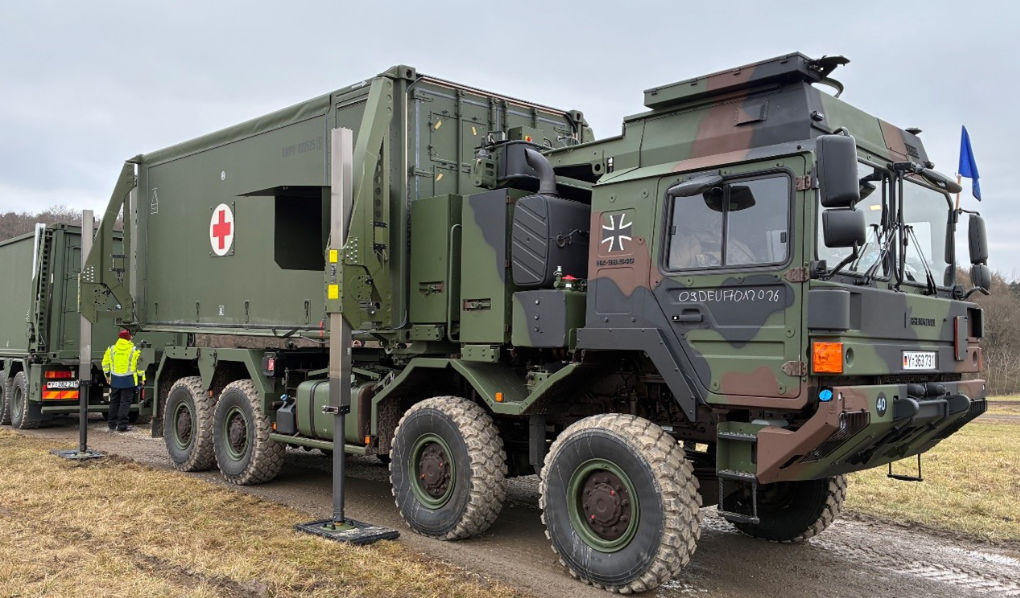
- Rheinmetall received a call-off worth over €500 million for 149 additional protected and unprotected mobile rescue stations.
- The order raises the Bundeswehr’s total to 165 systems worth over €600 million, with production starting in Q1 2027.
- Each two-container station provides mobile emergency treatment, can operate independently for several days and can be rapidly deployed by four soldiers.
DUSSELDORF, Germany — Rheinmetall will supply the Bundeswehr with 149 additional mobile rescue stations, expanding a previous order under a framework contract. The new call-off, valued at over €500 million, was booked in July 2026 and aims to bolster emergency medical care for troops.
Order Expansion
The latest order increases the total number of rescue stations to 165 systems, with a gross value exceeding €600 million. This call-off represents the largest order to date for Rheinmetall Project Solutions GmbH under the framework contract awarded at the end of 2024. Production of these systems is scheduled to commence in the first quarter of 2027.
The initial contract, signed in December 2024 with the Federal Office of Bundeswehr Equipment, Information Technology and In-Service Support (BAAINBw), commissioned Rheinmetall to supply up to 137 rescue stations, including ten ballistically protected and six unprotected systems. The current contract includes options for further armored and unarmored systems, alongside personnel training.
System Capabilities
The mobile rescue stations are integral to the Bundeswehr’s Modular Medical Facilities system, designed to provide initial emergency medical care for troops. Each system is highly mobile and can be set up and dismantled by four soldiers in a short timeframe. They consist of two containers, each equipped with a generator and air conditioning, capable of independent operation for several days.
The stations feature a fully equipped emergency treatment area and four additional treatment stations, with medical equipment mounted on configurable Airliner rails. A custom lifting system allows deployment on varied terrain and inclinations, and the systems can be transported using standard Bundeswehr carrier vehicles. Rheinmetall Mobile Systeme GmbH manufactures the modular 3:1 containers, which replace more complex tent structures.
Strategic Importance
The procurement of these highly mobile medical systems reflects a key lesson identified from the war in Ukraine, emphasizing the necessity of agile medical support for military operations. The Bundeswehr is acquiring both protected and unprotected versions of the system to meet diverse operational requirements.